Posts from the ‘defining the digital humanities’ Category

“Day of DH 2014” is occurring this April 8th:
http://dayofdh2014.matrix.msu.edu/
Here’s the info from the About page at Day of DH 2014:
A Day in the Life of the Digital Humanities (Day of DH) is an open community publication project that will bring together scholars interested in the digital humanities from around the world to document what they do on one day. This year, Day of DH will take place on April 8th. The goal of the project is to create a web site that weaves together a picture of the participant’s activities on the day which answers the question, “Just what do digital humanists really do?” Participants document their day through photographs and text, all of which is published on a community online platform (which, for this year, lives at dayofdh2014.matrix.msu.edu). Both during and after the day, people are encouraged to read and comment on their fellow participant’s posts. Eventually, all the data will be grouped together, undergo some light semantic editing, and released for others to study. We hope that, beyond the original online publication, the raw data will be of use to those interested in further visualization or digital community ethnographic research.
Author: Sarah Lozier
As a humanities graduate student interested in looking at digital media, digital processes, and digital sociality, it is tempting to define myself professionally as a Digital Humanities scholar. But this definition isn’t particularly helpful, since it almost always elicits the response — “And what does that actually mean?” Indeed, being a DH professional seems to “mean” differently for different people, and these definitional slippages become increasingly problematic when it comes to those non-research necessities of being an aspiring academic (getting jobs, applying for grants, and teaching undergraduates). In an effort to think through some of these slippages and their politics, I’d like to look at one specific resource for DH professionalization — the University of Victoria’s Digital Humanities Summer Institute (DHSI) — to think about what this program suggests effective DH professionalization is and does.
The DHSI is “a week of intensive coursework, seminars, and lectures,” all focused around issues pertinent to the digital humanities. This year’s twenty-seven seminars cover a wide range of topics ranging from “Text Encoding Fundamentals” to “Electronic Literature in the Digital humanities,” but all twenty-seven are organized along a kind of divide between building digital skill sets — coding, software use, etc — and dealing with fairly traditional issues of humanities study applied to digital objects — “reading” electronic literature, applying “theory” to digital media, etc.
This divide strikes me as potentially indicative of the larger problem of professionalizing in DH, and that is the question of what a DH professional does. While these seminars cover topics dealing explicitly with navigating the Digital and topics dealing explicitly with navigating the Humanities, there aren’t any seminars that explicitly deal with digital AND humanities navigation, DH as one unit. They suggest that DH is still D and H, Digital and Humanities. The problem with this “and” is analogous to the problem of the hyphen conceived as the splice that Katherine Hayles discusses in the fifth chapter of How We Became Posthuman. That is, D (and) H imagines a “separate but equal” relationship between the items on either side of the and, even as it officially splices them together (DH) as one item. Scholars who do this thing called “DH” must actually do “D and H,” making the discipline a necessarily exclusive rather than inclusive one. In the hectic world of the modern academy, where tenure is disappearing and we are asked more often than not to work “for free,” today, being a DH professional is all but closed off to those who already have the time and resources to equivalently pursue D and H — established, funded academics. Until we can more effectively splice D and H into DH, this exclusivity and definitional slipperiness will continue to exist.
Response by Rochelle Gold
Every September, the new MLA Job Information List (JIL) offers a snapshot of the state of the field for literary scholars. Roopika Risam’s recent blog post “Where Have All the DH Jobs Gone?” points out that in spite of the hype around digital humanities as the next big thing, digital humanities job opportunities are dwindling. After reading through the JIL, Risam concludes that while a number of job postings, including 17 literature positions, call for digital humanities as a secondary area of expertise, very few postings seem to look for digital humanities as a primary research field. As a result, she argues that “the explicitly DH job is perhaps the most endangered species on the JIL.” To her credit, Risam specifies throughout her blog post that her results are necessarily tentative as job postings are continuously added to the MLA job list throughout the fall. Nonetheless, it is hard to fully understand to what extent Risam’s point about the digital humanities becoming “endangered” makes sense without more context of the humanities job market as a whole. We especially need to know how the number of digital humanities jobs compares to other subfields. I accessed the job list several weeks after Risam to see if her conclusions hold. As Risam herself points out, the JIL can be unwieldy as different search terms yield different results. I will give just a few partial yet suggestive examples. The search terms “Victorian” and “19th century” yielded nine and 11 results respectively. On the other hand, “digital media” and “digital humanities” generated 27 and 32 results. My unscientific tinkering on the JIL points to the extremely harsh realities of the job market overall. While the digital humanities job pool may be shrinking, this seems to reflect the broader trend of the disappearance of jobs in literature and the humanities. Comparatively, digital humanists are probably still faring a little better than the rest, but, of course, that is not saying much at all.
Read Risam’s original post here: http://roopikarisam.com/2013/09/15/where-have-all-the-dh-jobs-gone/
The Politics of DH Professionalization
While the digital sphere has often been understood as a disembodied site of engagement, scholars within DH are increasingly challenging the field to examine its own universalizing tendencies that privilege the white, male producer. As Moya Bailey suggests[i], the increasing visibility of the field calls for an increasing reflexiveness about its own politics: “The move ‘from margin to center’ offers the opportunity to engage new sets of theoretical questions that expose implicit assumptions about what and who counts in digital humanities as well as exposes structural limitations that are the inevitable result of an unexamined identity politics of whiteness, masculinity, and ablebodiness.” The question of “what and who counts” as DH scholarship includes an inherent ability bias, as well as a reclamation of masculinities often labeled “geek” or “nerd.”
As a self-proclaimed “big-tent” field, DH proposes an engaging model of scholarship that embraces interdisciplinary, collaborative approaches that challenge the field and period-specific approaches of many traditional humanities departments. But are those claims valid if the field isn’t aware of its own politics of privileging certain types of users and scholarship? Can we read certain texts, such as the DH Manifesto, as endorsing certain modes of engagement while excluding others? What are the challenges to making the field more engaged with its own biases? What are the possibilities of addressing these politics before the borders of the field become solidified?
The stakes of such questions become apparent with even a quick reading of the last two MLA JIL. While Roopika Risam laments the drop in DH jobs this year, the wide array of posts seeking DH skills as either a primary or secondary specialty suggest the continued appeal of the field. Given the discussion of the possible politics of the field, what does it mean to market yourself as a DH scholar? Even more importantly, what is at stake for young scholars, particularly job seekers, to offer alternative forms of DH scholarship? What would those forms look like and what do they offer that is currently missing? Are there institutional politics that determine the types of DH scholarship or skills privileged? Are there already important reparative politics within DH that need to be recognized? Does the skill bias within the field limit the types of scholars and scholarship possible within DH? Is it possible to be both a DH scholar and a cultural/historical/literary critic and what are the sites of enrichment and tension between these practices? How do you understand your own position within the field as a young scholar and how do these questions emerge in your own research? Are these important questions to consider or is there another, similarly important agenda that DH is advancing?
[i] Bailey, Moya Z. “All the Digital Humanists are White, All the Nerds Are Men, but Some of Us Are Brave.” Journal of Digital Humanities 1: 1 (Winter 2011) n.p. Web.
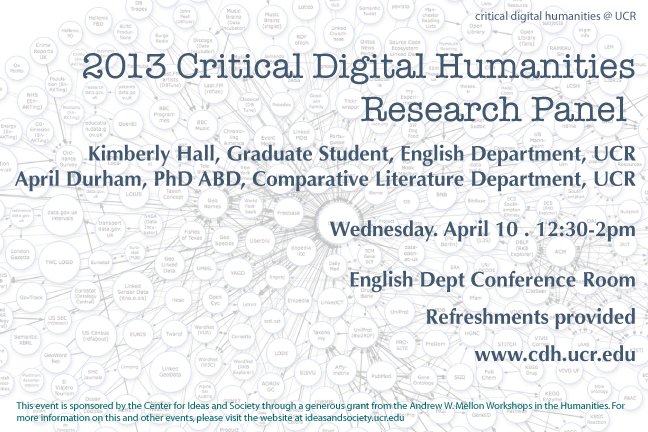 The Critical Digital Humanities presents a CDH research panel with presentations by April Durham and Kimberly Hall. They will present drafts of recent research in digital humanities for discussion and comment.
Wednesday . April 10 . 12:30 – 2
English Department Conference Room
Refreshments will be served.
New CDH Talk : Production & Pedagogy with Professor James S. Tobias
February 25th, 2013
April Durham
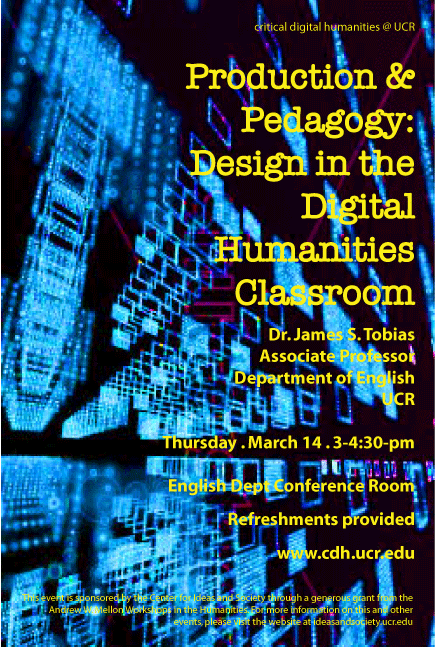
Production and Pedagogy: Design in the Digital Humanities Classroom
Dr. James S. Tobias . Associate Professor . Department of English . UC Riverside
Thursday . March 14 . 3-4:30 pm . English Department Conference Room
Refreshments provided.
This event is sponsored by the Center for Ideas and Society through a generous grant from the Andrew W. Mellon Foundation. For more information on this and other events, please visit the website at ideasandsociaty.ucr.edu
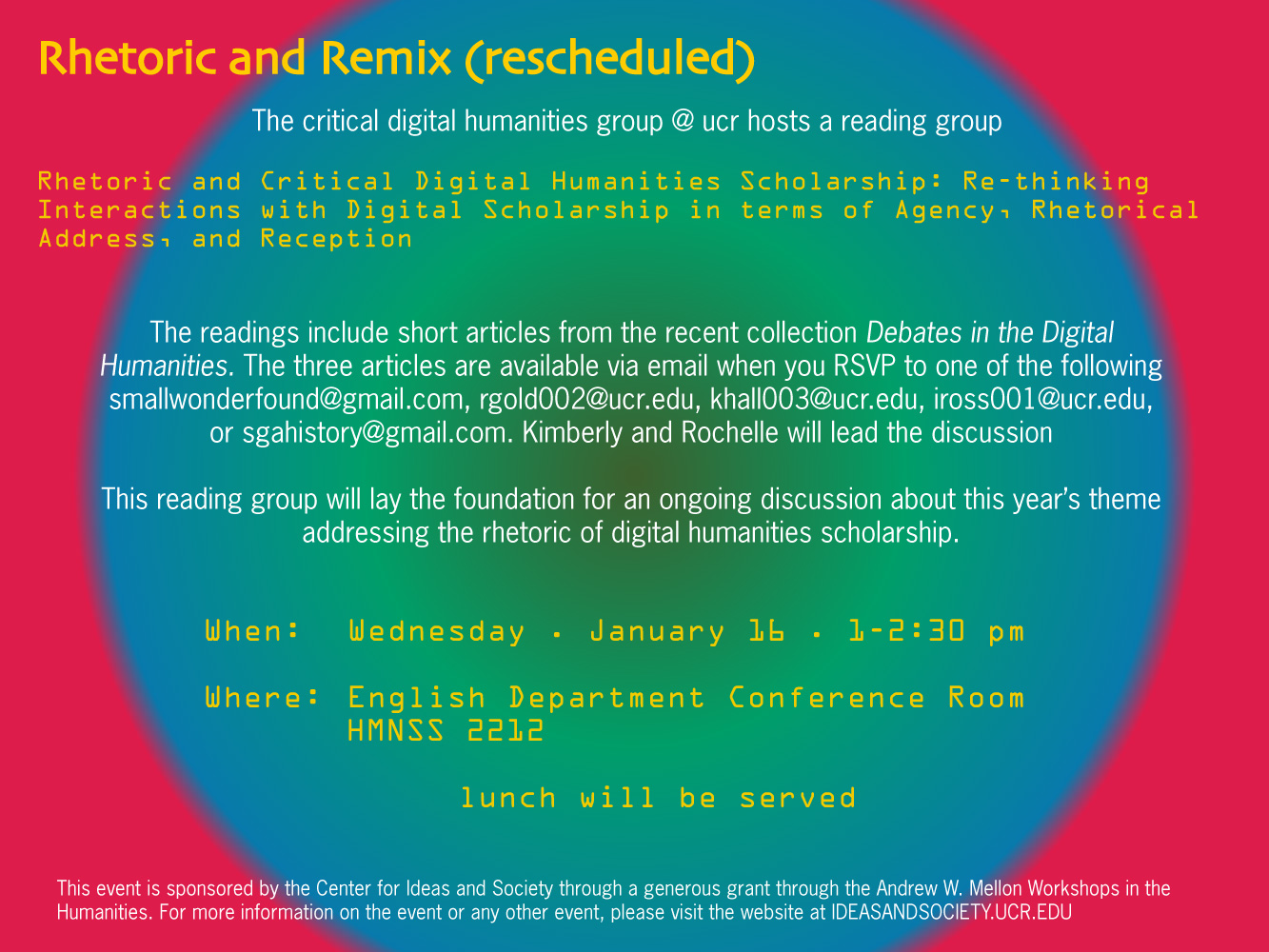
 The Critical Digital Humanities group at UCR announces a reading group:
“Rhetoric & Critical Digital Humanities Scholarship: Rethinking Interactions with Digital Scholarship in terms of Agency, Rhetorical Address, and Reception”
The readings include short articles from the recent collection Debates in the Digital Humanities. The three articles are available by emailing your RSVP. Please see the flier below for the addresses. Kimberly and Rochelle will lead the discussion
This reading group will lay the foundation for an ongoing discussion about this year’s theme addressing the rhetoric of digital humanities scholarship.
WHEN: Wednesday . January 16 TIME: 1-2:30
WHERE: English Department Conference Room . HMNSS 2212
lunch will be served!
The three articles from Debates in the Digital Humanities are also available at the links below:
Lisa Sipro, “This is Why We Fight: Defining the Values of the Digital Humanities”
Alan Liu, “Where is the Cultural Criticism in the Digital Humanities”
This event is sponsored by the Center for Ideas and Society through a generous grant from the Andrew W. Mellon Workshops in the Humanities.
This event has been rescheduled – please see this post for details:
http://cdh.ucr.edu/2013/01/06/rhetoric-and-remix-reading-group-rescheduled/
The Critical Digital Humanities group at UCR announces a reading group:
“Rhetoric & Critical Digital Humanities Scholarship: Rethinking Interactions with Digital Scholarship in terms of Agency, Rhetorical Address, and Reception”
The readings include three short articles from the recent collection Debates in the Digital Humanities and Bernard Stiegler’s book, For a New Critique of Political Economy. Participants should obtain the Stiegler book as we will be discussing it in its entirety.
This reading group will lay the foundation for an ongoing discussion about this year’s theme addressing the rhetoric of digital humanities scholarship.
WHEN: rescheduled for January 16th, 1-2:30pm
WHERE: English Department Conference Room . HMNSS 2212
lunch will be served!
This event is sponsored by the Center for Ideas and Society through a generous grant from the Andrew W. Mellon Workshops in the Humanities.
Despite its title Stephen Marche’s article, “Literature is not Data: Against Digital Humanities,” is more against the algorithmic era we currently live in than the digital humanities. Marche writes that “algorithms are inherently fascistic,” but the concern is really about readability.
Algorithms are a tool for distant reading, as Marche states; however, the problem arises when algorithms need to be read themselves. A close reading of an algorithm is problematic, except of course for those mathematicians, computer scientists, and other professionals trained in such procedures. Overall, it is difficult to see whether Marche is really worried about the power wielded by the creators of the algorithms, or the social acceptance of relying on algorithms in general.
The irony of Marche’s misguided polemic is its underlying call for a greater understanding of the “smooth machines” that run the algorithmic code. Instead of being against the digital humanities, Marche is really pointing to a change in modern society, a detachment from the visceral world of the analog to the somewhat intangible, but very material world of the digital.
Marche’s anxiety expresses itself first through the amorphous nature of the burgeoning digital humanities. Marche then skewers academia, complains about Google, and shudders in fear of an electronic, financial armageddon. For Marche, literature is something to be handled, touched, and loved. Data, in contrast, is lifeless, meaningless, and untrustworthy.
Algorithms are not inevitable, and they are not perfect, but they are definitely part of the modern technological world we live in. The goal of the digital humanities is not to be “the next big thing,” but to understand the bigness of the algorithms that are already all around us.
While here in our corner of the net, we are working on figuring out the potentials of “contemporary transmedia theory and practice” including interdisciplinarity and collaboration, the MLA is concerned with getting a grip on the parameters for evaluating digital scholarship and the structures both departments and individual scholars need to support one another. After twelve years, the MLA has issued updated guidelines to address the interdisciplinary, collaborative, and practical aspects of digital scholarship.
Because we require institutional legitimacy to have access to the normal trajectory of an academic career, these guidelines are important and necessary. If we want to be able to make solid arguments with traditionalists like Stanley Fish But as it is important to also be critical of state apparatuses, I would like to point to the ways in which these guidelines tend to contain the very openness that is the potential of this work. Of course I’m not arguing for a reprieve from the intense rigors demanded of any kind of scholarship. But I do find that efforts to understand that comprise lists and limiting language are generally about limiting the unexpected, the chaotic, the weirdness that a field like digital humanities (especially when it includes the critical) is constantly renewing by its very nature.
So while the MLA guidelines are meant, in all consciousness, to support the varied ways digital scholarship can exist and to encourage departments interesting in including digital scholars in their faculty to open themselves up to “invasion” from other disciplines or formats for scholarship that may not include paper publications, it also begins the fencing-in that is the road to “state machine” status (to use a D&G concept) or in other words, it begins to frame the ways in which even such untraditional projects as bizarrely mapped digital archives or interactive, spatial texts can be limited to narrowly defined categories and institutional parameters.
